

Industry
Industrial Manufacturing
Challenge
Low user adoption, fragmented processes and high technical debt had turned a heavily customized CRM into a constraint on a global, multi‑division sales organization.
Results
Through a structured 7-step transformation methodology and a greenfield reset, the client now runs a standardized, scalable CRM built on Microsoft Dynamics standards, with a global rollout to more than 700 salespeople and first-time CRM access for five additional countries.
Key Product
Microsoft Dynamics 365, Microsoft Copilot, Microsoft Teams, Microsoft SharePoint

About the company
The client is a global high‑technology engineering company specializing in cutting tools and hard material solutions for machining and wear protection. It is a privately held company and part of a larger industrial group, one of the world’s leading specialists in powder‑metallurgical materials.
The Challenge
This case study describes a large-scale CRM transformation for a global, multi-division organization. The initiative was triggered by low user adoption, fragmented processes, and growing technical risk. Through a structured, outcome-driven approach, CRM was repositioned from a limiting system into a scalable, business-critical platform supporting collaboration, transparency, and sustainable growth.
The organization operates globally across multiple divisions and regions, serving diverse customer segments through direct sales and partner-driven models, with complex sales structures, diverse customer touchpoints, and high demands on transparency and collaboration. CRM plays a central role across Sales, Marketing, Service, and Operations, making usability, scalability, and governance critical success factors.
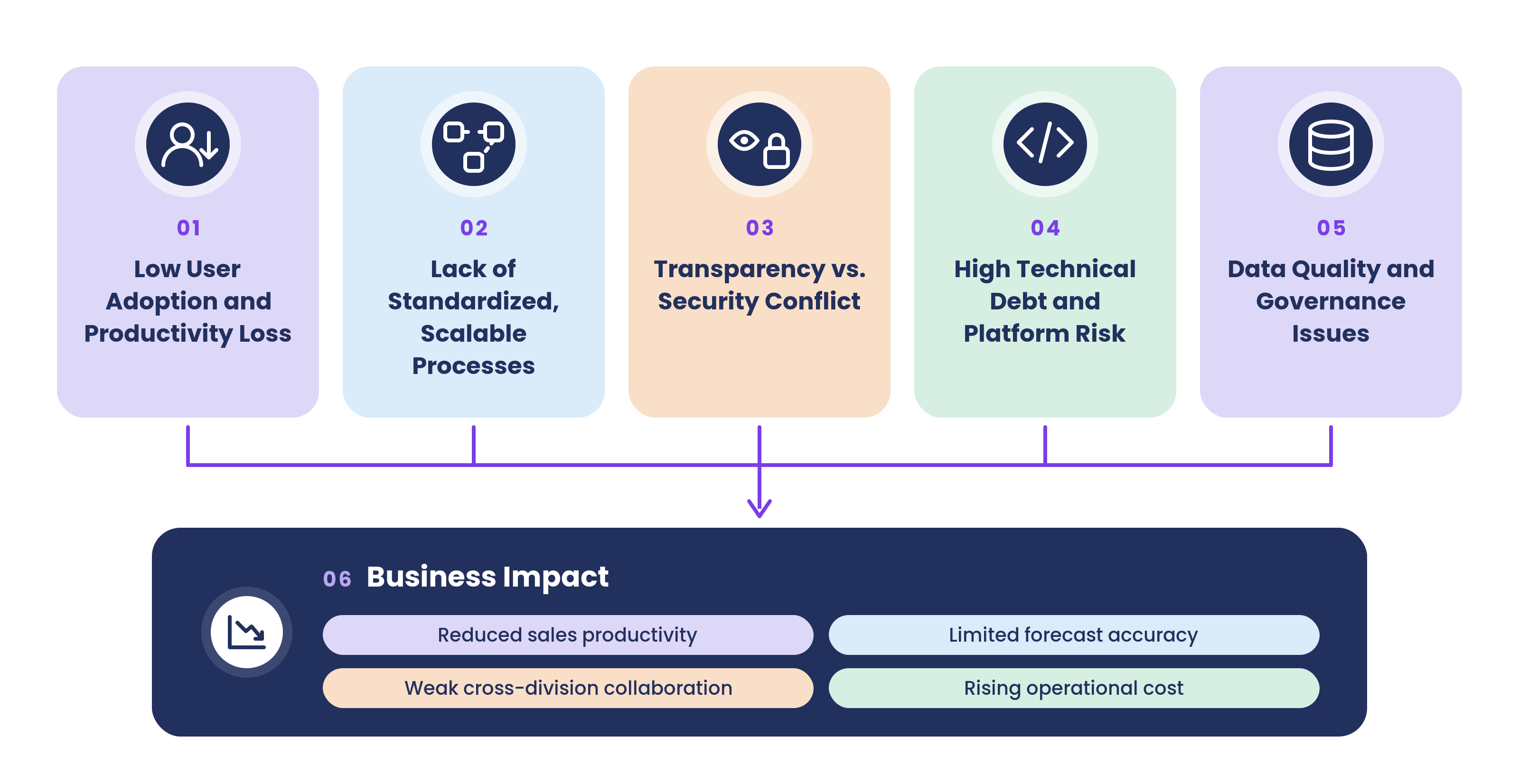
1. Low User Adoption and Productivity Loss
Despite significant investment, the existing CRM delivered limited value to end users. A global user experience survey revealed strong dissatisfaction driven by a non-intuitive interface, excessive complexity, and inefficient workflows—particularly in Sales. Core tasks required too many clicks, slowing daily work and reducing productivity. As a result, teams increasingly bypassed CRM and relied on shadow tools such as Excel and OneNote, fragmenting customer data and undermining collaboration
2. Lack of Standardized, Scalable Processes
Core business processes were neither consistently defined nor globally aligned. Divisions and regions had implemented their own variations, resulting in inconsistent execution and limited comparability. There was no clear ownership for global end-to-end processes, weakening governance and scalability. Critical flows—from lead generation to opportunity, quote, order, and invoice—were implemented in a fragmented and technically constrained manner.
3. Transparency vs. Security Conflict
Management required a CRM model that balances divisional focus with cross-division transparency on shared customers. The existing security and visibility model was heavily customized and unable to support this requirement in a sustainable way. Complex, non-standard logic increased maintenance effort and introduced governance and compliance risks.
4. High Technical Debt and Platform Risk
The CRM solution had drifted far from platform standards, relying on extensive custom development and undocumented logic. Key elements such as data models, calculations, reporting, and integrations required reverse engineering. This created high dependency risk, limited upgradeability, and put future innovations—such as native AI and automation capabilities—at risk.
5. Data Quality and Governance Issues
Customer and master data governance was inconsistent across regions. Some business units maintained critical data outside of CRM, while unstable or incomplete interfaces caused data inconsistencies and manual corrections. As a result, management lacked a reliable single source of truth for customer, pipeline, and performance data.
6. Business Impact
Together, these issues resulted in reduced sales productivity, limited forecast accuracy, weak cross-division collaboration, and rising operational cost. Instead of enabling growth and efficiency, CRM increasingly acted as a constraint on strategic execution.
7. Why Change Was inevitable
Management recognized that incremental optimization would not address the structural issues. A fundamental reset was required to eliminate technical debt, harmonize processes, restore user trust, and re-establish CRM as a scalable backbone for the organization’s commercial operations. This realization marked the starting point of a comprehensive CRM transformation initiative.
Our Solution - 7 Step CRM Transformation Methodology
To resolve the structural, organizational, and technical challenges, the project followed a clear, step‑by‑step CRM transformation methodology. The approach was designed to deliver sustainable business outcomes, restore user trust, and establish a scalable foundation for long‑term growth.

Step 1 – Establish a Clear CRM Vision and Guiding Principles
The transformation started by defining a shared CRM vision positioning the system as the central hub for Sales, Marketing, and Service. Guiding principles focused on user adoption, outcome over output, standard-first design, collaboration, and long-term scalability. This vision acted as a decision framework across all phases of the program.
Step 2 – Define a Robust Operating Model and Governance
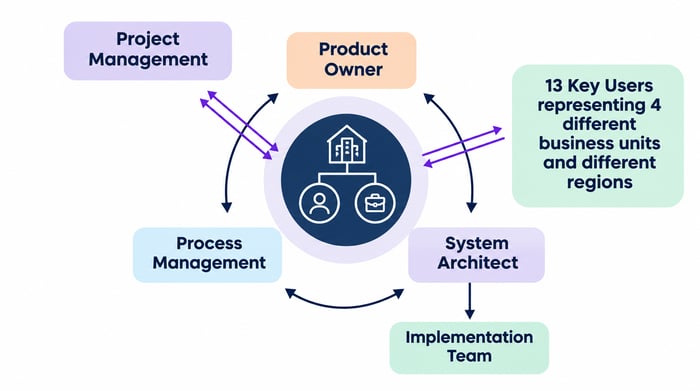
A ONE‑Team operating model was introduced, combining business, IT, and external expertise. Clear ownership roles, strong business accountability, and an empowered steering committee ensured fast decision-making, transparency, and alignment.
Step 3 – Execute a Greenfield Reset
Instead of incremental optimization, a greenfield CRM approach was chosen to eliminate technical debt and legacy constraints. This enabled a clean system architecture, standardized processes, and future‑proof platform capabilities.
Step 4 – Apply the Double Diamond Method
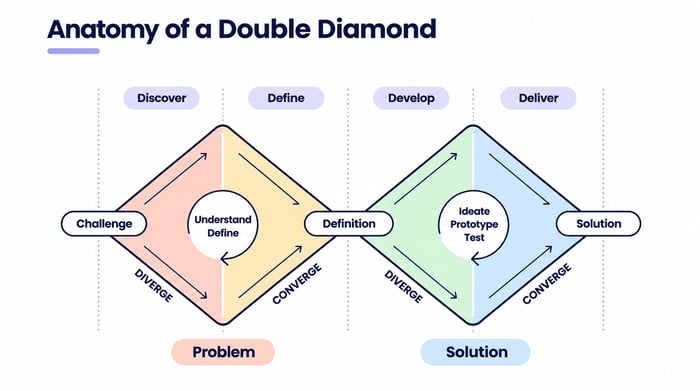
A Double Diamond framework structured discovery and delivery. Ideas and requirements were first explored and validated before being transformed into clearly defined use cases and user stories. This ensured that only high‑value, well‑defined items entered development.
What is the Double Diamond Framework?
The Double Diamond framework divides the design process into two main stages: understanding the problem and developing the solution.
The first diamond focuses on exploring challenges and identifying the real problem that needs to be solved. The second focuses on developing, testing, and refining possible solutions.
The two diamonds meet at a key point: problem definition. Clearly understanding the user's needs is essential before moving forward with a solution.
Step 5 – Deliver Through Agile, Outcome‑Driven Execution
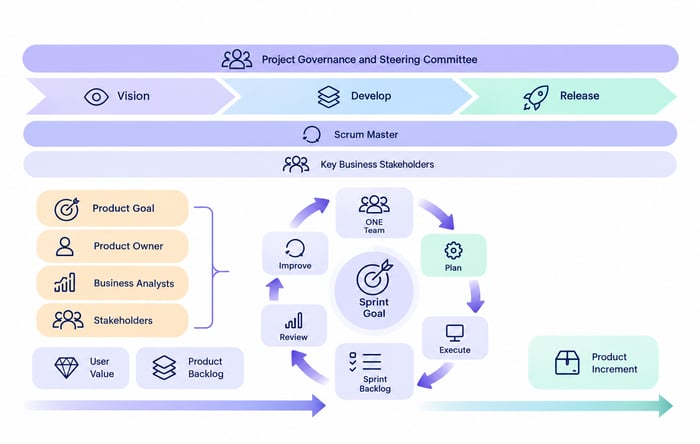
The solution was delivered using agile principles with a strong focus on business value. Sprint goals, a prioritized backlog, and clear definitions of ready and done ensured quality, predictability, and continuous stakeholder feedback.
Project Execution
Value and Outcome-Driven CRM Implementation
Step 6 – Design for Transparency, Security, and Scalability
A modern security and visibility concept was introduced making use of standard concepts of data accessibility and data visibility. Territories, roles, and views replaced complex custom logic, enabling cross‑division transparency while maintaining confidentiality and governance.
Step 7 – Anchor Adoption Through Training and Enablement
User adoption was embedded from the start through local key user networks fully integrated into the CRM setup and development to continuously refine and improve the CRM and tailor it to their specific business needs. In addition, they acted as ambassadors of the CRM in the whole organization. CRM adoption was positioned as a productivity enabler rather than an administrative task.
Results & Impact
The CRM transformation delivered measurable business impact by replacing fragmented legacy structures with a standardized, scalable, and future‑ready CRM foundation. The initiative did not only modernize technology, but fundamentally improved governance, transparency, and user adoption across regions and divisions.
Established a Solid CRM Foundation Based on Standards and Best Practices
The program successfully built a robust CRM core grounded in Microsoft Dynamics standard functionality and recommended best practices.
By deliberately minimizing customizations, the organization created a sustainable platform that is easier to maintain, enhance, and upgrade over time.
As a result:
- Technical complexity and long‑term risk were significantly reduced
- The CRM platform became future‑proof for new Microsoft releases and innovations
- The system is now positioned as a stable backbone for global Sales, Marketing, and Service operations
Implemented a Flexible Security Model Using Standard Functionality
A key outcome was the introduction of a modern, flexible security and visibility concept based entirely on standard Microsoft Dynamics capabilities rather than custom-built logic.
Instead of rigid, hard‑to‑maintain security constructs:
- Data accessibility was clearly separated from data visibility
- Roles, territories, and views replaced complex custom security layers
- The model supports cross‑division collaboration while protecting sensitive data
This approach significantly improved governance, reduced maintenance effort, and enabled scalable expansion without increasing system complexity.
Introduced High‑Impact Functional Capabilities
The transformation delivered several new capabilities that directly improved business effectiveness and user productivity:
-
Opportunity Management
A standardized, global opportunity management model was introduced to create transparency across the sales pipeline. This enabled consistent opportunity handling, improved forecasting, and better management visibility across regions and divisions.
-
Microsoft Copilot
With the move back to platform standards, the foundation was laid for Copilot and AI‑supported scenarios. This opens up new possibilities for productivity gains, insights, and automation, positioning the CRM as a forward‑looking digital workplace.
-
Microsoft Teams Integration
Tight integration with Microsoft Teams enabled seamless collaboration directly from CRM records. Sales and service teams can now collaborate in context, reducing tool switching and improving information flow.
-
Microsoft SharePoint Integration
The integration with SharePoint established structured document management linked directly to CRM entities. This ensured consistent access to customer‑relevant documents while maintaining governance and version control.
-
Custom Territory Management Solution for Complex Account Assignments
A dedicated territory management solution was implemented to handle many‑to‑many account assignments, enabling multiple sales representatives across divisions to work collaboratively on shared customers. This addressed a critical requirement of the multi‑division sales model without breaking platform standards.
-
Dynamic Classification for Strategic Account Planning
A dynamic customer and account classification model was introduced to support strategic account planning. Instead of static segments, classifications adapt based on business context, enabling better prioritization, focus, and data‑driven decision‑making.
-
Successfully Onboarded New Regions into CRM for the First Time
A major milestone was the first‑time CRM onboarding of several international regions that never had access to a CRM at the client before, including:
- United States
- Canada
- Mexico
- Brazil
- India
These regions were integrated into a unified global CRM landscape, creating consistent processes, shared visibility, and a common data model. This marked a decisive step toward a truly global CRM operating model and significantly improved cross‑regional alignment and transparency.
In total the new CRM system was rolled out to more than 700 Salespeople across the globe.
Overall Business Impact
Together, these results transformed CRM from a limiting legacy system into a scalable, collaborative, and future‑ready platform. The organization now operates on a standardized foundation that supports growth, enables innovation, and strengthens alignment across Sales, Marketing, and Service — globally and across divisions.
Conclusion
The CRM transformation at the client demonstrates how a well‑governed, outcome‑driven approach can turn a fragmented legacy system into a scalable global platform that actively supports business strategy.
By deliberately moving away from incremental fixes and heavy customization, the client established a CRM foundation built on standard Microsoft Dynamics functionality, clear governance, and user‑centric design principles. This decision proved critical in reducing long‑term technical risk, restoring user trust, and enabling continuous innovation without reintroducing complexity.
The transformation went far beyond technology. It created clarity in processes, transparency across divisions, and a common operational language for Sales, Marketing, and Service. The introduction of standardized opportunity management, AI‑readiness through Copilot, deep Microsoft 365 integrations, and dynamic account classification significantly strengthened commercial steering and collaboration.
Equally important, the CRM initiative enabled the client to act as a truly global organization. The successful first‑time onboarding of regions such as the United States, Canada, Mexico, Brazil, and India marks a decisive step toward a unified global CRM operating model. With more than 700 sales users working on a shared platform, the client now benefits from consistent data, comparable performance insights, and improved cross‑regional alignment.
Today, CRM is no longer perceived as an administrative burden or technical constraint. It has become a strategic business platform—supporting scalable growth, improved decision‑making, and ongoing innovation across the Group. The project provides a strong blueprint for how complex, multi‑division organizations can successfully modernize CRM while keeping governance, adoption, and long‑term sustainability firmly in focus.
Considering a CRM reset but need guidance? We're here to help. Learn more about our Consulting Services.
Ready to get started?
