Everyone is probably tired of hearing that people don't search on Google or click on links as much as they used to. Well, there's some truth to it. Here’s what you should be doing to optimize your content and be the first one AI cites:
- Structure content so AI can extract it
- Write short, objective sentences
- Turn your headers into questions
- Add tables and FAQs
- Use schema markup
- Write about what you know
- Let a human review everything
- Track your performance
Read more about each tip below and download our checklist for additional insights and practical ways to apply them to your content.
Table of content:
What is AEO and why does it matter?
Answer Engine Optimization (AEO) is the practice of optimizing your content so that AI tools like ChatGPT, Gemini, Perplexity, and Google’s AI Overviews can easily find, understand, and reference it when answering users’ questions.
Search behavior has changed. People no longer type two or three keywords into Google and scroll through ten blue links. They ask full questions and expect a direct answer, often without clicking anywhere. If your content isn't the source behind that answer, you're invisible to a growing share of your audience.
The good news: AEO doesn't replace good SEO or good writing. It builds on both. Below are practical tips to make your content easier for AI to read, trust and quote, without losing the human reader along the way.
How should you structure content so AI can extract it?
Structure every section so it can stand on its own. An AI doesn't read your article the way a human does, from the first line to the last. It scans, breaks the page into chunks and pulls out the passage that best answers a specific question.
That means each paragraph should make sense even if it's lifted out of context. In practice:
- Lead with the answer. Put the key point in the first sentence of each section, then add context.
- One idea per paragraph. If a paragraph covers three ideas, an AI can't cleanly quote any of them.
- Avoid vague references. Phrases like "as mentioned above" or "this approach" lose their meaning once extracted. Name the thing again.
- Use lists for steps and options. Numbered steps and bullet points are easy for AI to parse and reuse.
A simple test: copy any paragraph into a blank page. If it still makes sense, it's AI-ready.
Download our checklist to follow all the steps to create AEO-optimized content.
Why do short, objective sentences work better for AI?
Short, objective sentences are easier for AI to understand and quote accurately. Long sentences packed with clauses, jargon and qualifiers make it harder for a model to identify the actual claim.
Aim for clarity over cleverness:
- Keep most sentences under 20–25 words.
- State facts directly: "AEO focuses on answers, not rankings" beats "It could be argued that AEO, in many ways, tends to focus more on answers."
- Cut filler words like "basically", "in order to" and "it's important to note that".
- Define terms the first time you use them.
This also helps your human readers. Most people skim online content, and clear sentences respect their time.
Why should your headers be written as questions?
Question-based headers match the way people now search. Users ask Google and AI assistants full questions like "How do I improve my email open rates?" rather than typing "email open rates tips". When your header mirrors that question, AI can easily connect it to the user's prompt.
The key is pairing each question with a clear answer right below it:
- Write the header as a real question your audience asks. Check sales calls, support tickets, "People also ask" boxes and your own AI prompts for inspiration.
- Answer it in the first one or two sentences under the header. Be direct, then expand.
- Keep a logical hierarchy. Use H2s for main questions and H3s for follow-up questions.
Of course, not every header has to be a question, but your most important sections should be.
How do tables and FAQs help AI understand your content?
Tables and FAQs give AI structured, ready-to-use answers. They organize information into clear pairs (question and answer, item and attribute) that models can extract with very little interpretation.
Use tables for comparisons. Whenever you compare options, features, prices or processes, put them in a table instead of a long paragraph. For example:
| |
SEO
|
AEO
|
|
Goal
|
Rank on search results pages
|
Be cited as the answer by AI tools
|
|
Main platform
|
Google, Bing
|
ChatGPT, Gemini, Perplexity, AI Overviews
|
|
Content focus
|
Keywords and backlinks
|
Clear questions and direct answers
|
|
Success metric
|
Rankings, clicks, traffic
|
Mentions, citations, AI referral traffic
|
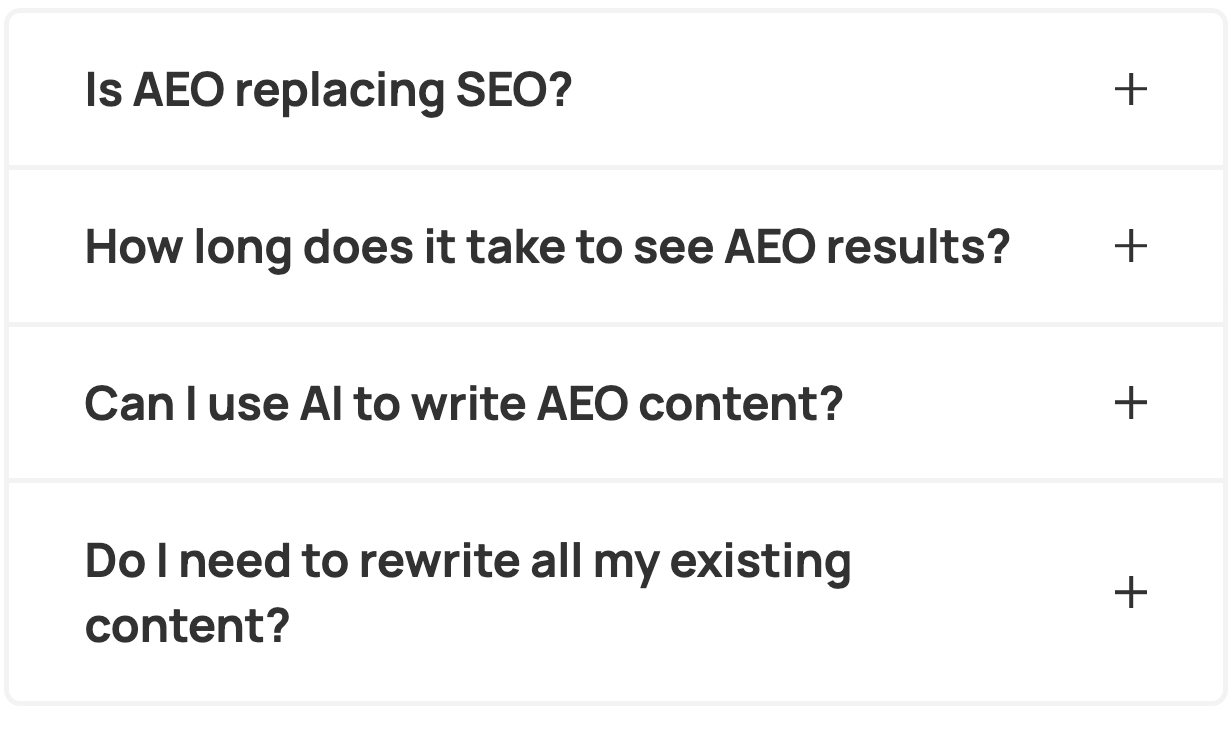
Add an FAQ section. End your article with three to six questions your readers actually ask, each followed by a short, complete answer (two to four sentences). FAQs capture long-tail questions and are among the easiest content formats for AI to quote.
What is schema markup and why do you need it?
Schema markup is code you add to your page that tells search engines and AI exactly what the content is. Instead of guessing, they read a label: this is an article, this is an FAQ, this is a how-to guide, this is the author.
The most useful schema types for content marketing are:
- Article / BlogPosting – identifies the page as an article, with author, publish date and headline.
- FAQPage – marks up your question-and-answer pairs.
- HowTo – structures step-by-step instructions.
- Organization and Person – connect the content to a real company and a real author, which builds credibility.
Most CMS platforms, including HubSpot and WordPress, let you add schema through settings, plugins or a JSON-LD snippet in the page header. Once added, validate it with Google's Rich Results Test or the Schema.org validator.

Example: HubSpot
Should you write about everything or focus on what you know?
Focus on what you know. AI tools favor sources that show consistent, deep expertise on a topic, not brands that publish a little about everything.
Think of it this way: a marketing agency should write about marketing. A HubSpot partner should write about HubSpot, CRM and RevOps. A cybersecurity company should write about cybersecurity. When your content clusters around a clear area, AI starts to associate your brand with that subject and is more likely to cite you.
To build that topical authority:
- Pick your core topics and map the questions your audience asks about each one.
- Create content clusters: one in-depth pillar page per topic, supported by articles that answer specific questions and link back to it.
- Share first-hand experience: real examples, client results, original data and opinions. This is what generic AI-generated content can't copy.
- Say no to off-topic trends. Trying to please everyone dilutes your authority.
Being the go-to source for one area beats being a forgettable source for ten.
Do humans still matter in AEO?
Yes. Humans still matter, and they (we) make the difference. You're optimizing for AI, but the people reading, sharing and buying are still human. And AI tools are increasingly trained to favor content that shows real expertise and trustworthiness.
Before you publish, always review the content yourself:
- Proofread everything. Typos, broken links and awkward phrasing hurt credibility with readers and machines alike.
- Fact-check claims and numbers. If you used AI to help draft, verify every statistic and source. AI can sound confident and still be wrong.
- Add a human voice. Personal insights, opinions, examples and stories make content memorable and harder to replace.
- Show who wrote it. A named author with a short bio and relevant experience signals trust.
AI can help you write faster. Only a human can make sure it's accurate, useful and on-brand.
How do you measure AEO performance?
You measure AEO by tracking how often AI tools mention and cite your brand, and how much traffic they send you. AEO isn't a one-time task; it's an ongoing cycle of publishing, measuring and improving.
What to track:
Review your top pages every few months. Update outdated stats, add new questions and restructure sections that aren't being picked up.
Optimizing for AEO comes down to one idea: make your content easy to understand, easy to extract and easy to trust. Structure it clearly, answer real questions directly, stay focused on what you know, and let humans have the final word. Do that consistently, and AI tools will start pointing your audience to you.
Sources:
